
Does Evolution Prove Babylon's Pagan Creation Story (And Genesis Wrong)?
How evolution's story (not its science) seems to conflict with Genesis

My wife, Shannon, recently watched a documentary on Netflix about dinosaurs. I watched a couple of episodes with her. She was filled with wonder for the beauty and power of the creatures that seemed so alien yet familiar, and Morgan Freeman’s baritone serenade propelled the grand narrative of these not-lizards ever forward. Needless to say, she became deeply emotionally invested.
Of course, we all know the ending to this hundred-million-year-old tale. The final episode recounts the entire globe combusting into flames from a meteor half the size of Manhattan plummeting to the earth like losing paradise by way of pride (shout out Milton).
Shannon, overwhelmed with compassion for these lost creatures, cried at the end of the documentary—real tears of compassion. Their extinction and suffering devastated her. She took some comfort that chickens are the descendents of those ancient creatures (all birds are), and so their spirit lives on.
Still, it was a tear-jerker for her—and rightly so. But why? And does the violence written into nature’s history undercut Genesis?
Science and faith: The Big Bang—easy mode
My Nando’s Sauced protein wrap, coffee, and nicotine from Pipe tobacco are not currently sitting well; but such are the conditions a writer must suffer in service of their craft. Much like my Tesco meal deal (not sponsored), the Big Bang did not sit well with Christian thinkers in 20th century. Well, for evangelical thinkers, anyway. Now, it’s widely accepted and even used by apologists as a primary source of evidence for the doctrine of Creatio Ex Nihilo (creation from nothing) and perhaps even God’s existence.
Dr. William Lane Craig, for example, commonly uses this scientific paper by Bord, Guth, and Valenkin as proof in support of the premise that the universe has a finite past. So, in a few short decades, Christians have integrated a major scientific finding into our beliefs that we once thought hostile. Not only that, we’ve subjugated it in service of classical theism. As Pope Francis said, “The Big Bang, which today we hold to be the origin of the world, does not contradict the intervention of the divine creator but, rather, requires it.”
Evolution is not so simple. It seems to remain a staunch enemy after two centuries. At best, we have tried to allow for a technical literal co-existence with readings of the Bible. But this is not nearly sufficient.
Evolutionary theory is not merely a set of facts set in a scientific theory; it provides a story of the cosmos.
The theory of evolution as a science
First, the science of evolution. Evolution provides a causal account of the diversity of species by natural selection—or, at least, an explanatory account. Evolution, unlike other scientific disciplines, cannot predict the future in an experimental setting or give certain answers about the past. There’s too much noise and randomness. For example, theories of physics should predict and then be confirmed by an experimental outcome. At least, in theory they should—looking at you string theory! Gravity = x, so when I drop this apple in a vacuum, it will fall in y seconds at z distance.
Evolution does not do this. Instead, it provides an explanatory account of why species are diverse without precise predictions. Of course, it predicts that species will diversify under certain environmental pressure. For example, selective breeding and the environmental pressure of human care will result in wild dogs becoming tiny nippy rat-dogs.

However, past shared ancestry of, say, whales and mice is more complicated. There are good theories to show with a high degree of confidence that, counterintuitively, whales and mice do share a common ancestor. They are both mammals. In this case, there is fossil evidence of that ancestor. But just because we can give a good guess as to past shared ancestors, we cannot predict what whales’ descendants will look like in 10 million years. Additionally, there are huge gaps in the fossil record where common ancestors must be stipulated and considered based on DNA evidence.
This process of identifying past ancestors is called phylogenetic inference—the practice of inferring shared common ancestors. Often, real, tangible evidence “underdetermines” what we can confidently conclude about shared ancestors, so there will always be lingering mysteries in evolution. All this to say, evolution is a science, but not a science like physics. This is a rough-and-ready account from a non-scientist, so take things with a chunk of salt.
Evolution as a competing story
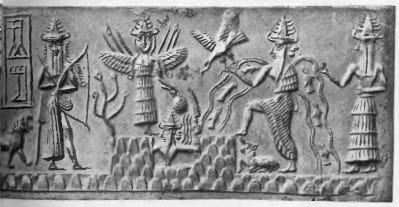
Personally, I’ve never been too bothered by the seeming contradiction between the Genesis account of creation and the literal processes of evolution. There is only a conflict between the scientific theory of evolution and Genesis if you interpret Genesis 1-3 as an Enlightenment and/or fundamentalist (literalist) lens of history and science. Genesis is not such an account. In my understanding, it has never claimed to be—Genesis is neither a science nor history textbook.
What kind of work is Genesis, then? Craig calls the early chapters of Genesis a “mytho-history,” a kind of literature that takes proto-historical events and retells them in mythical terms. Genesis took its literary form, in part, to counteract the creation myths of Babylon and Egypt. In his recent book, In Quest of the Historical Adam, Craig argues God took two Homo heidelbergensis and put them in a garden and breathed a soul into them plausibly about 1 million to 750,000 years ago.
Good—I like this view. It seems very plausible, although I’m not a fan of classical dualism.
However, there’s a deeper problem. Evolution is not like the Big Bang; evolution presents a cosmological story about nature—it is its own kind of myth. And it seems to compete with the Genesis 1-3’s mytho-history telling of our cosmic origins.
Evolution has a narrative lesson: millions of years of conflict, violence, death and suffering are essential to life’s existence. You can postulate a kind of teleological evolution whereby the invisible hand of God “helped” evolution move along. But this does not remove the prerequisite suffering and death required for evolution’s movement.
On the other hand, Genesis depicts the world as “good.” This means millions of years of death and suffering are somehow “good,” since this process is inevitably captured in the act of creation part of the creation story. Actually, I believe I could defend a position that such suffering comes out good in the end. For example, I could say beauty only comes from suffering and death gives an existential source of meaning through its finiteness, or something like it.
But this is not the position Genesis seems to give.
It is true that a kind of chaos exists in Genesis that God contends with (waters without form and void), but chiefly, God deals with this chaos without conflict.
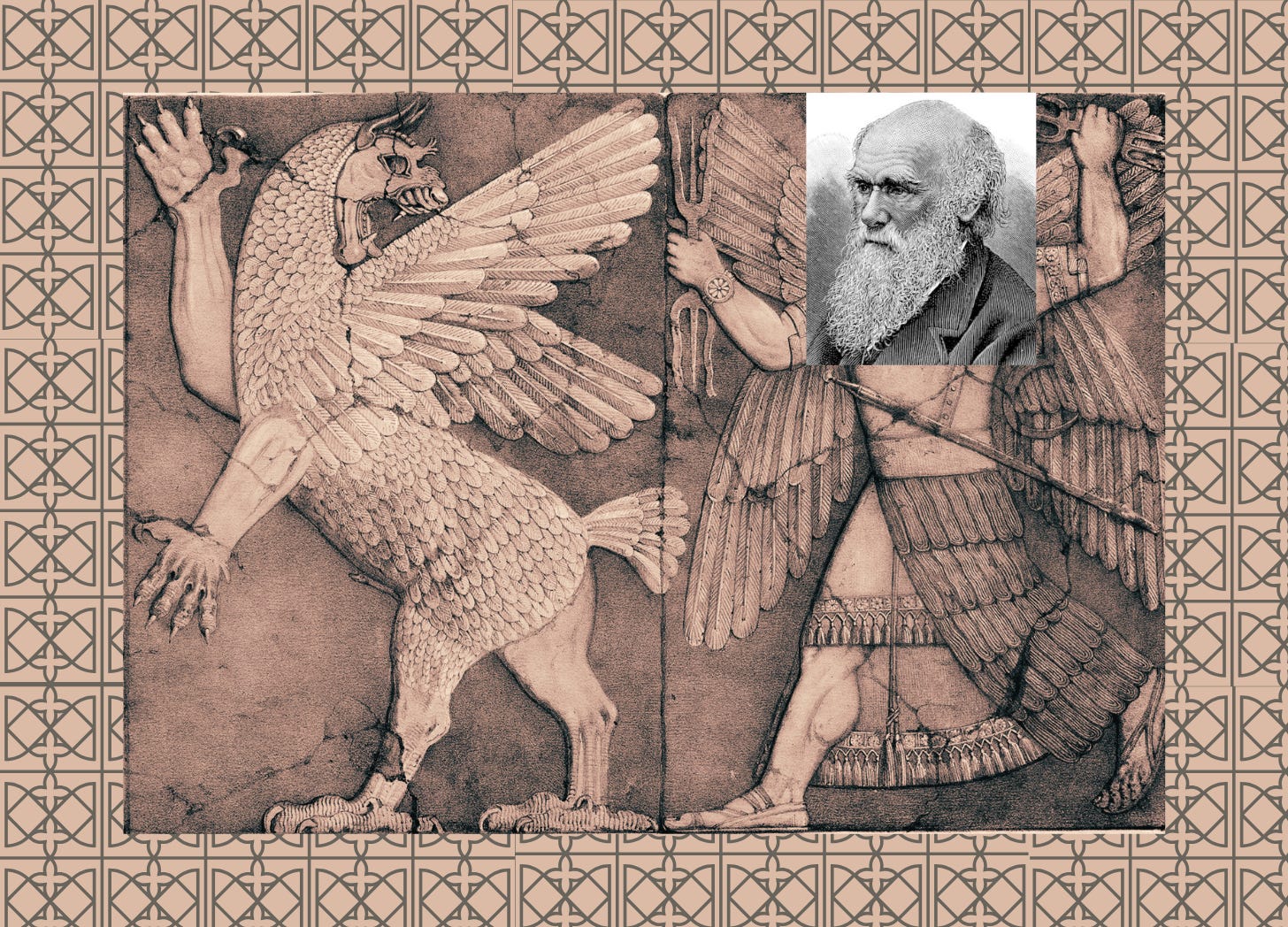
In other ancient creation myths, the universe falls out of brutal, cosmic war. For example, the Enūma Eliš from Babylon describes a horrible clash, where the heavens become one half of the body of a dragon-god Tiamat, and the earth is the second half of the torn body. The cosmos is an unhappy accident born of gods fighting; and it just so happens to give deification to the particular king and elevate the race of peoples the myth originates from. What a nice coincidence!
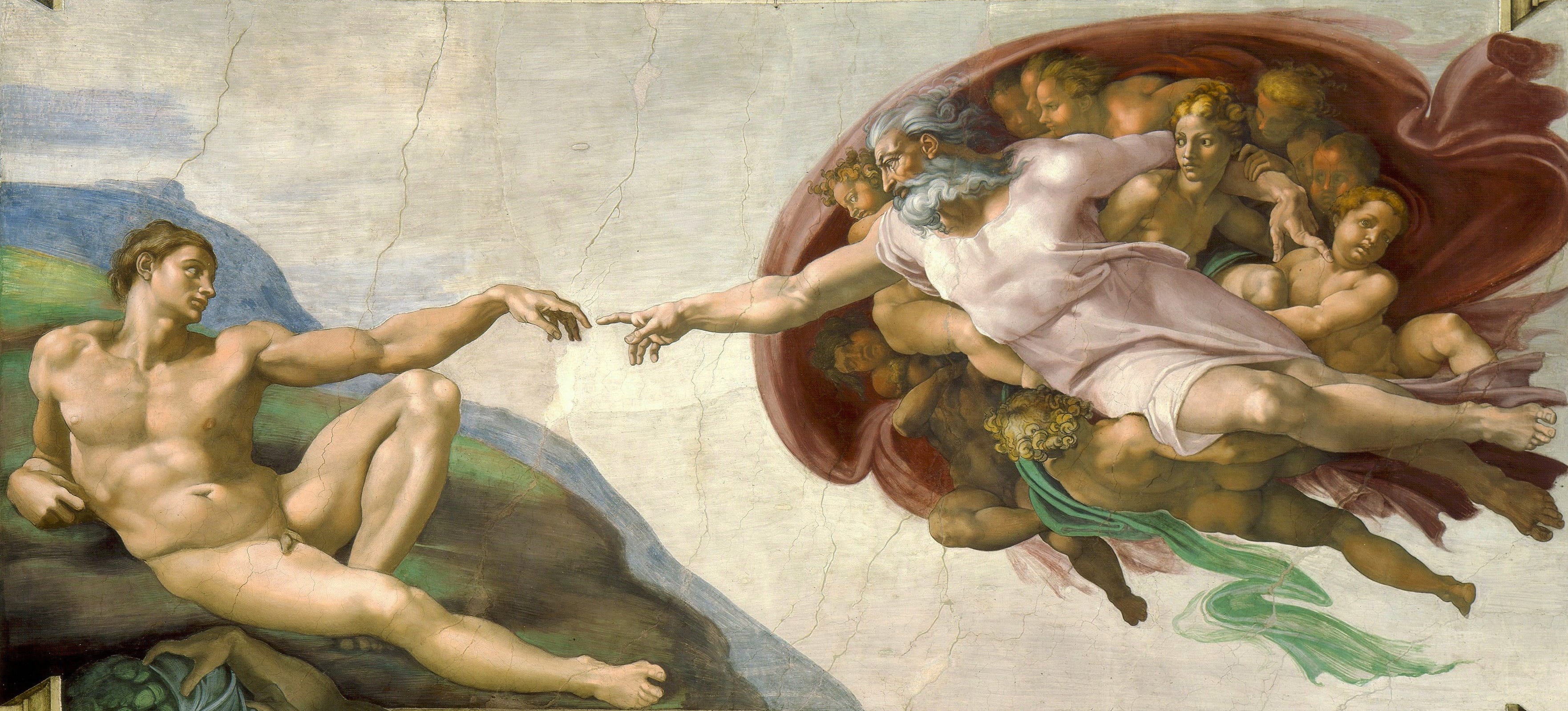
This, crucially, does not happen in the Genesis myth. God harmonizes the chaotic waters of the universe’s non-existence into form and reality. But there is no astral bloodshed, divine wars, or death involved. And the Israelites are not portrayed as set above other races. It is a profoundly egalitarian creation story.
However, the evolution account puts forward violence and conflict as central to the universe. It does not provide evidence for or against the Babylon deities duking it out; fossils underdetermine evidence for or against this supernatural story, let’s say. But it does seem to oppose the otherwise peaceful, non-violent account of Genesis.
In other words, the problem is that the myth part of Genesis, not the historic part of the mytho-history, seems to be contradicted by evolution—even if evolution is not itself an ancient myth. Evolution tells a causal and explanatory account of the cosmos, and it depends on death and conflict, whereas Genesis depends on original creation before the Fall being “good.”
Of course, evolution is not just about death.
Evolution includes a story about life.
A way out?
The problem with evolution as death is life must also multiply for evolution to progress. For every death of a short-necked giraffe because it starved, there is a longer-necked giraffe who enjoyed the spoils of its genetic “luck,” and that slightly longer-necked giraffe got to have sex and give birth to lots of giraffes. But survival and reproduction of the fittest isn’t enough.
It’s now widely agreed that mating preferences can exert massive pressure as well. For example, the male peacock’s beautiful feathers have negative survival fitness. It seems like a consensus among scientists, and was even postulated by Darwin himself, that male peacocks’s trains are attractive to females despite their lack of survival advantage. Maybe the trains are attractive to females because they signal the males are so strong, they can overcome the survival limitations of a large train. This is a hypothesis called the Handicap Principle. (Presumably, this is why modern women date performative males.) The Handicap Principle seems to be hotly debated and has little to no empirical evidence in its support. That’s what Wikipedia told me anyway.
Nevertheless, the uncontested principle is that sexual preference through feminine choice and, therefore, life, vitality, and freedom are the true keys to evolution.
Perhaps this is a way out. On a macro level, the story of the origin of the world is a good one, “teeming” with life; where, under the guiding grace of the Creator, creatures strive toward the goal of beautiful and diversified life over hundreds of millions of years. The pressure comes from death, yes, but also from love.
Perhaps it is only from the human perspective that the laws of nature seem so cruel. After all, predators eat prey, and we don’t blink. A cat plays with the mouse before eating it, fine. Whereas a human torturing a wounded deer would raise outrage. Rightly so, of course.
Perhaps, then, from a divine perspective, such “cruelty” contained in the animal’s perspective still allows the creation of the world to be “good.” It’s a case of divine ordering and borders along ethical black and whites. This is maybe why humans can have moral responsibility to non-human animals, but non-human animals cannot have moral responsibility toward other animals.
And perhaps the wilderness outside the garden was goodness as potential, so that the humans could “rule” and care for the dominion of animals through living by God’s wisdom. And that, as Genesis says, is “very good.”
If all that sounds like hedging, it is. I don’t have answers. It’s my best stab, but I suspect that after my current PhD, I will need to spend some years thinking about it.
Thanks for reading.
Soli Deo Gloria
Awesome post Mark. Touching on a pretty important question most Christians (and those who take Christianity seriously) should consider. Reminds me of a book I read back in my undergrad--"The Priestly Vision of Genesis I" by Mark S. Smith--which argued essentially for the same things you argued for. Genesis is not and should not strictly be seen as history, but a characterization of God and creation rather. And yes, he situates it post-Babylon too. I remember it being pretty influential in my own historiography of the Bible, and Bart Ehrman himself shouted out the book and seemed to agree with its position.
I'm curious as to where you get the idea that the evolution narrative is intrinsically violent and conflict-driven from. I'm not a scientist, but I'm wondering if that is a popular view? I get that survival of the fittest is a thing, but that always seemed to be an accidental byproduct of efficiency rather than a direct result of violent, conflict-driven change.
Thanks for this - I appreciate your articulation of this tension. My understanding would be to see creation outside of the Garden as being good but wild and untamed.
There’s also the whole question of what the Fall entails, and what Paul meant by saying death came through Adam - my read on Genesis is that Adam and Eve were intended for immortality by eating from the tree of life (symbolising choosing to trust God and remain in right relationship with him). But it doesn’t imply that humans were in themselves constitutionally immortal before the Fall or that animals didn’t die. I’d be interested to read you develop your thoughts on this further!